
Surface posts that are semantically related to whatever the reader is looking at, using vector embeddings rather than tag overlap.
How it works
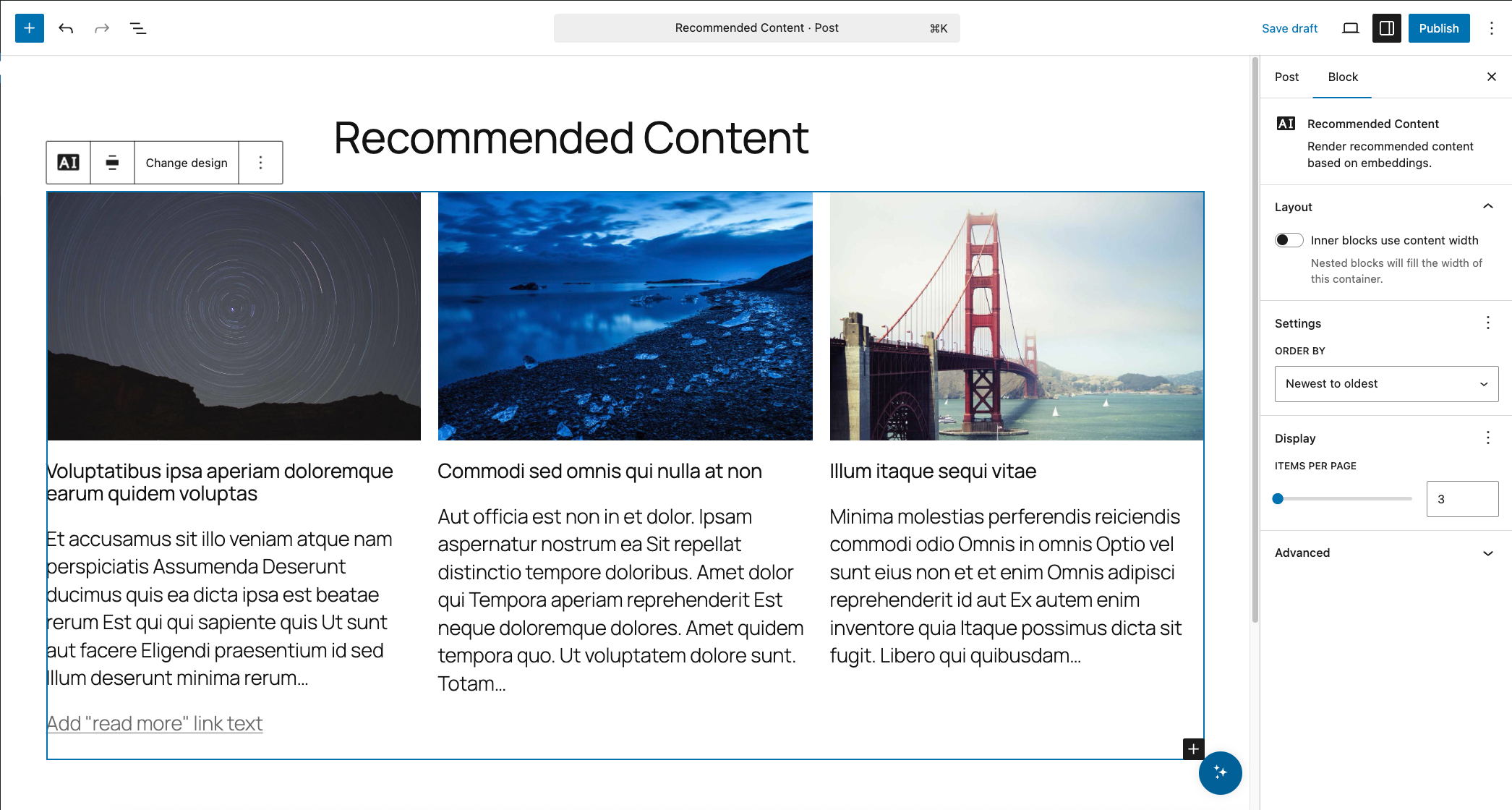
Recommended Content adds a Recommended Content block (and a matching shortcode and REST endpoint) that, given the post the reader is currently on, returns the most semantically similar published posts from the same site. Unlike the classic WordPress “related posts” pattern that depends on tag and category overlap, ClassifAI generates an embedding vector for every published post in scope and ranks recommendations by cosine similarity — so a post tagged differently but actually about the same subject still surfaces. Embeddings are generated and refreshed in the background as posts are published or updated, and they are stored as post meta.
Configuration
- Post types in scope for recommendations.
- Number of recommendations rendered per block.
- Ordering preference (similarity, recency, or a mix).
- Provider and model selection.
- Allowed roles and an allowed-users list for granular access control.
Providers
As of the current ClassifAI release, Recommended Content supports a single provider:
- OpenAI Embeddings
The broader embeddings provider set used by classification, term cleanup, and Smart 404 has not yet been wired into Recommended Content.
Use cases
- Keeping readers inside the site after they finish a long-form article.
- Surfacing useful related coverage on archives where the editorial taxonomy is sparse.
- Replacing legacy “related posts” plugins that ranked by tag overlap rather than meaning.